Karol Tchorek’s studio. Mariusz Tchorek’s and Katy Bentall’s place
The Studio is open for viewing on Tuesdays between 10AM and 6PM, and on Saturdays between 10AM and 4PM.
Join a guided tour in English every Saturday at 1:00 PM (during the summer season). Tickets online.
Visiting the Studio is possible upon purchasing a ticket via the website bilety.muzeumwarszawy.pl or at the ticket desk of the Museum of Warsaw located at 42 Old Town Market Square.
Ticket price:
- regular 20 PLN, concessions 15 PLN,
- group (more than 10 people) normal 15 PLN per person, concessions 10 PLN per person,
- family 40 PLN (max. 2 adults, 1-6 children).
Address: 36 Smolna St., apartment 11
Organized groups or study visit: edukacja@muzeumwarszawy.pl
Space rental: marketing@muzeumwarszawy.pl
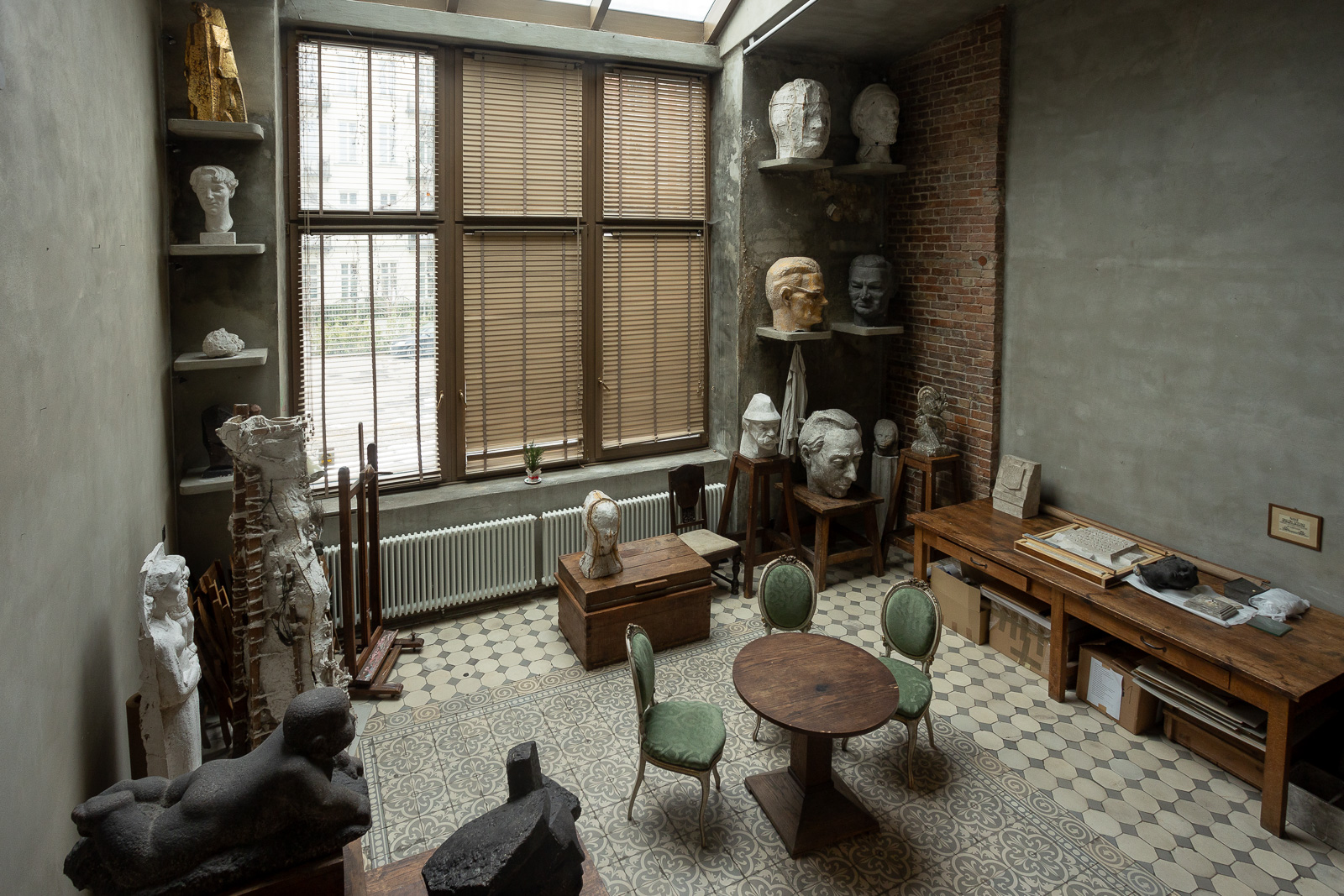
The studio of Karol and Mariusz Tchorek and Katy Bentall, with the preserved works by the artistic family, memorabilia, archives and furnishings, is a unique place on the map of Warsaw. It holds many overlapping historic and artistic layers.
Karol Tchorek – sculptor
Karol Tchorek (1904–1985), a sculptor, author of portraits and monuments, medalist and art dealer, built his Studio in the early 1950s from the remnants of a demolished annex of a tenement house at 36 Smolna Street. He transferred part of the furnishings and architectural details from his previous studio and gallery located at 63 Marszałkowska Street.
On Smolna Street, Tchorek produced his most renowned works:
- Motherhood (1952), the tombstone of Władysław Strzemiński,
- Warsaw Autumn (1975)
- and, above all, he coordinated the realization of plaques commemorating street executions carried out by the Nazi occupying force in Warsaw (designed in 1949).
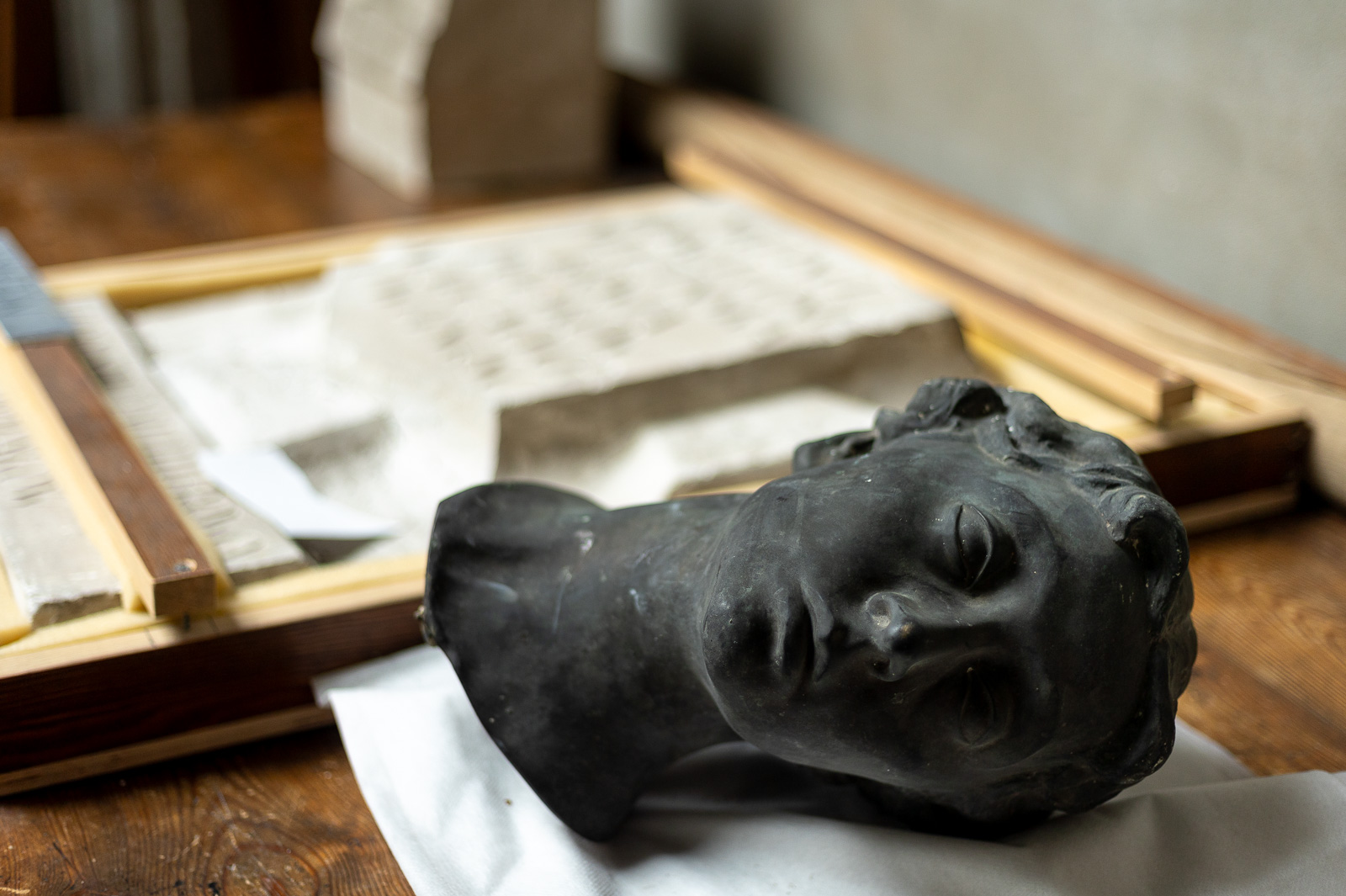
In addition to models of these works, the Studio also houses a few preserved pre-war sculptures by the artist (Little Roosters, 1937; Reclining Child, 1938), plaster models, sketches and drawings, as well as memorabilia from the ‘Nike’ Art Salon which Tchorek ran between 1943–1944 and 1945–1951. The Studio also stores part of Tchorek’s ethnographic collection, which he passionately built over the years, primarily sculptures by Leon Kudła known as “the Primitive from Powiśle” (1879–1964).
Mariusz Tchorek and Zofia Tchorek
Thanks to the efforts of Mariusz Tchorek (1939–2004), the sculptor’s son, an art critic, translator and therapist, and the sculptor’s widow, textile artist Zofia Tchorek (1916–2001), the Studio was entered into the register of historic monuments in October 1985. Over the following years, until his death in 2004, Mariusz Tchorek looked after his father’s legacy, all the while continuing his own work—writing and reflecting on his previous contributions in art criticism, translation and therapy.
Katy Bentall
The subsequent chapter in the history of the Studio began with Mariusz Tchorek’s passing. At that point, Katy Bentall, a British artist and Mariusz Tchorek’s widow, took over caring for the space.
She carried out a renovation of the Studio, initiated research into the legacy of both her husband and father-in-law, and began organizing their archives. She also transformed the Studio into a venue for exhibitions, meetings, artistic interventions and residencies. During this time, the Studio also served as a space for her own creative work, its points of reference being: the place itself, its history, and the art emerging there. It was in this studio that Bentall wrote her poems, produced paintings, objects and interventions were all created there.
In 2021, Bentall transferred the rights to the contents of the Studio to the City of Warsaw. Two years later, she made yet another donation, enriching the collection with the archive of Mariusz Tchorek, family mementos and the remaining part of the Studio’s historical furnishings.

Following the completion of inventory work, the Studio opened to visitors in February 2025. In honouring its past, we primarily envision it as a space for research and educational outreach related to the legacy of the Tchorek family, for hosting small educational initiatives and for fostering institutional collaboration.
We wish to carry forward the vision of Katy Bentall who saw the Studio as a place for meetings, intellectual exchange and artistic engagement.
Warsaw Historic Artists’ Studios
Tchorek’s Studio was among the first to be incorporated into the Warsaw Historic Artists’ Studios network in 2014. It is one of the oldest, largest and most richly resourced studios in the city. In managing the Studio, we work closely with the Office of the Capital City Conservation Officer which oversees the site in both formal and conservation capacities on behalf of the Mayor of Warsaw.